 English
 Español
 Indonesia
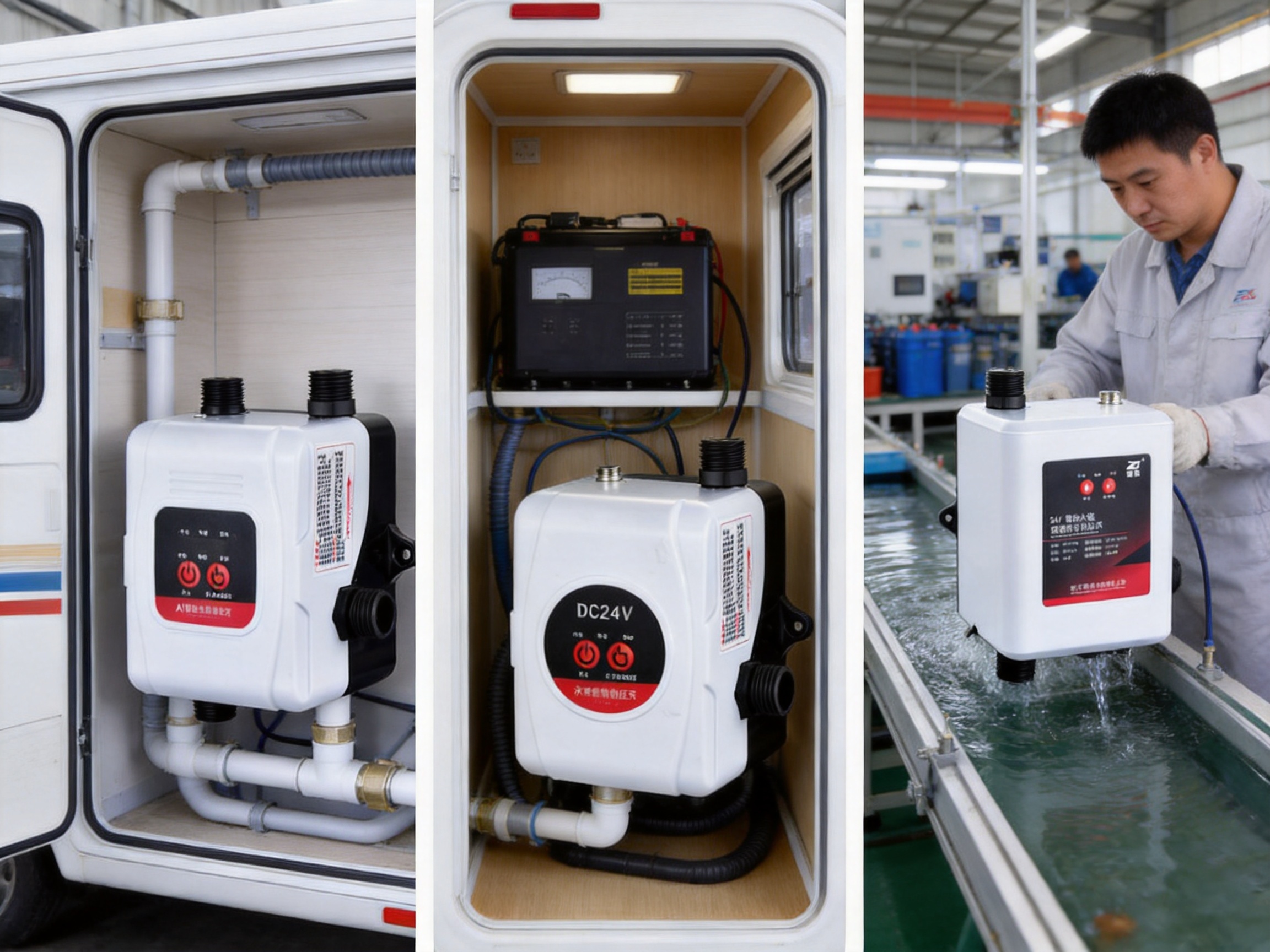
Reliable water pressure is essential in homes, recreational vehicles, small buildings, agricultural installations, and many distributed water-supply systems. When incoming water pressure is unstable or insufficient, users may experience weak shower flow, delayed faucet response, inconsistent irrigation performance, or difficulty supplying water to elevated points. A booster pump can solve these problems, but the choice of pump technology has a major effect on operating comfort, energy consumption, maintenance requirements, and long-term reliability.
The 24V intelligent permanent magnet variable frequency silent booster pump is designed for applications that require stable pressure, compact electrical compatibility, quiet operation, and automatic response to changing water demand. It combines a permanent magnet synchronous motor with an intelligent variable frequency control system. This combination enables the pump to adjust its operating speed according to demand rather than simply running at one fixed speed whenever power is available.
Compared with a conventional fixed-speed booster pump, this design can provide a more refined water-supply experience. The pump can start automatically when a tap, shower, appliance, or irrigation outlet requires water and stop automatically when the demand ends. During operation, the controller adjusts motor speed to help maintain stable pressure. The result is a system better suited to modern household water supply, mobile water systems, and other applications where comfort, efficiency, and electrical flexibility are important.
The pump is manufactured by Zhejiang ZhenTai Mechanical and Electrical Co., Ltd., a Chinese manufacturer specializing in aerators, air blowers, submersible pumps, and water pumps. The company’s product range covers more than 90 products across 10 series and serves applications including aquaculture, irrigation, drainage, environmental protection, household water supply, ecological landscape projects, and flood control. Its manufacturing background provides a broad technical foundation for developing and supplying water-moving equipment for different markets.
1. Product Overview
The intelligent booster pump is built around four central technologies: a 24V electrical configuration, a permanent magnet synchronous motor, variable frequency control, and automatic start-stop operation. Each function contributes to a specific user benefit, while the technologies work together as an integrated water-pressure solution.
The 24V version is rated at 100 W, with a maximum listed head of 19 meters, a listed flow rate of 1.9 cubic meters per hour, and a 20 mm caliber. These specifications make it suitable for relatively compact water-supply systems where a low-voltage power source is preferred. It can be considered for homes, cabins, recreational vehicles, boats, remote installations, backup water systems, and selected irrigation or utility applications.
The permanent magnet motor is designed to generate useful power with efficient electromagnetic operation. Unlike a basic motor design that depends on continuous high electrical input to maintain a magnetic field in the rotor, a permanent magnet motor uses permanent magnetic material in the rotating assembly. This construction can contribute to high efficiency, strong power output, improved power factor, and reduced operating noise.
The variable frequency controller changes motor speed in response to water demand. If demand is low, the pump does not necessarily need to operate at its maximum speed. If demand increases, the system can raise the operating speed to deliver more pressure and flow. This approach helps the pump respond more naturally to real-world usage patterns.
Automatic start and stop operation further improves convenience. When the system detects a demand for water, the pump starts. When demand ends, the pump stops. Users do not need to operate a separate switch every time they open or close a water outlet, provided that the installation is correctly configured and the water system meets the controller’s operating requirements.
| Specification | 24V Model | 220V Model 1 | 220V Model 2 |
| Model | ZTDC24V | ZTDC220V | ZTDC220V |
| Rated Power | 100 W | 400 W | 600 W |
| Listed Head | 19 m | 35 m | 35 m |
| Listed Flow | 1.9 m³/h | 2.7 m³/h | 3.5 m³/h |
| Caliber | 20 mm | 25 mm | 25 mm |
The 220V versions demonstrate that the product family can address a wider range of water-pressure requirements. The 400 W model is listed with a 35-meter head and 2.7 cubic meters per hour flow, while the 600 W model has the same listed head and a higher flow rate of 3.5 cubic meters per hour. Although this article focuses on the 24V model, the broader product range allows distributors and project buyers to select a suitable electrical and performance configuration.
2. Why Permanent Magnet Motor Technology Matters
Motor efficiency is one of the most important factors in a booster pump. A pump may operate for short periods in a domestic application, but frequent cycling or extended daily operation can make motor performance a major part of total ownership cost. A high-efficiency motor can reduce unnecessary electrical consumption while maintaining useful output.
The permanent magnet synchronous motor used in this pump is designed to combine efficient operation with strong torque characteristics. Permanent magnet technology can support high power density, meaning that a relatively compact motor can provide effective output. This is valuable when the pump must fit inside a limited equipment compartment, under a sink, in a vehicle, or inside a compact utility enclosure.
Permanent magnet motors can also operate with a high power factor. In practical terms, this means electrical input can be used more effectively for producing motor output. The exact energy savings in a particular installation will depend on operating time, water demand, system resistance, pipe layout, control settings, and local power conditions. Nevertheless, the motor technology provides a strong foundation for an energy-conscious water-pressure system.
Another advantage is the potential for smoother operation. A variable frequency drive can regulate motor speed instead of relying only on abrupt on-and-off operation. When properly controlled, the motor can accelerate and decelerate in a more measured way. This may reduce pressure shocks in the pipe network and create a more comfortable user experience at taps and showers.
Compared with a basic fixed-speed induction motor pump, the permanent magnet design is especially attractive where noise, compactness, efficiency, and frequent operation are important. A conventional pump may run at full speed each time it starts, even when the actual water demand is modest. The intelligent permanent magnet system is designed to adjust operation more intelligently.
2.1 High Efficiency for Repeated Water Demand
Household and mobile water systems rarely operate at one constant demand level. A user may open a small faucet for a few seconds, operate a shower at medium demand, and then run several outlets simultaneously. A fixed-speed pump treats these situations in a similar way, while a variable frequency system can adapt the motor speed to the changing requirement.
This adaptive behavior can help avoid excessive energy use during low-demand operation. It can also reduce the need for oversized equipment. When selecting a pump, buyers should consider the actual duty cycle and required pressure instead of choosing the largest available motor for every application.
2.2 Lower Noise for Indoor and Recreational Use
Noise is a major concern in homes, apartments, cabins, recreational vehicles, boats, and compact commercial spaces. A pump that produces strong vibration or frequent harsh starts can disturb users, particularly when installed near bedrooms, kitchens, bathrooms, or living areas.
The product is designed for low-noise operation through the combination of a permanent magnet motor, variable speed control, and silent booster pump structure. Noise performance in the field will also depend on mounting, pipe support, water conditions, air in the system, and enclosure design. Correct installation is therefore essential to achieve the intended quiet operating characteristics.
Compared with a basic high-speed pump that repeatedly starts and stops at full power, the variable frequency design can offer smoother operating behavior. The reduced intensity of acceleration and the ability to run at lower speeds during modest demand can help limit audible disturbance.
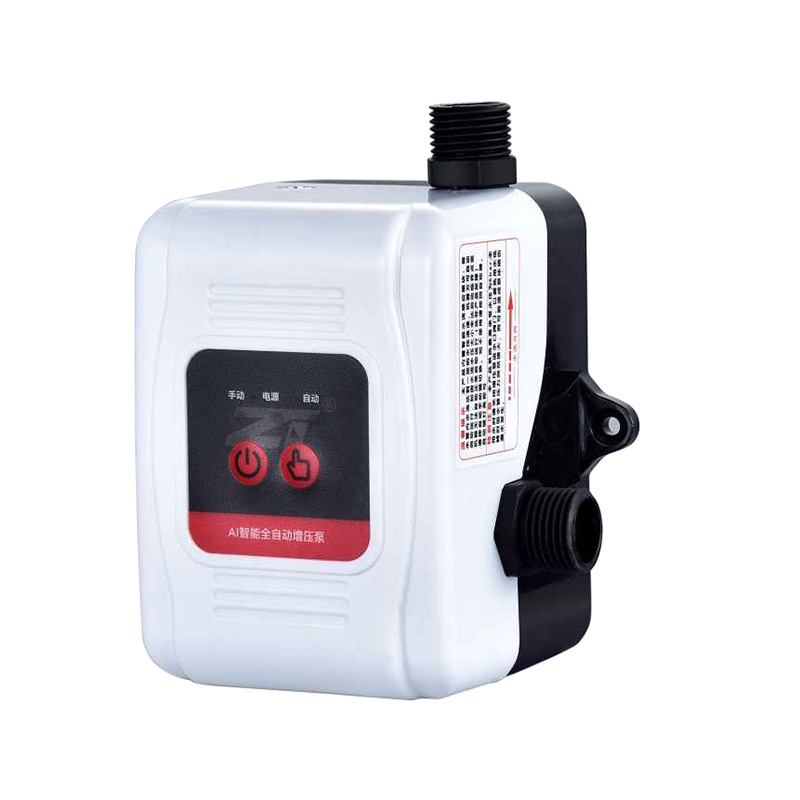
24V Intelligent Permanent Magnet Variable Frequency Silent Booster Pump
3. Intelligent Variable Frequency Pressure Control
The main difference between an intelligent booster pump and a simple pump is the way the system responds to demand. A standard pump may be turned on manually or controlled by a basic pressure switch. It generally operates at a fixed speed until the switch turns it off. This approach can be effective, but it may result in pressure fluctuations, repeated hard starts, and unnecessary full-speed operation.
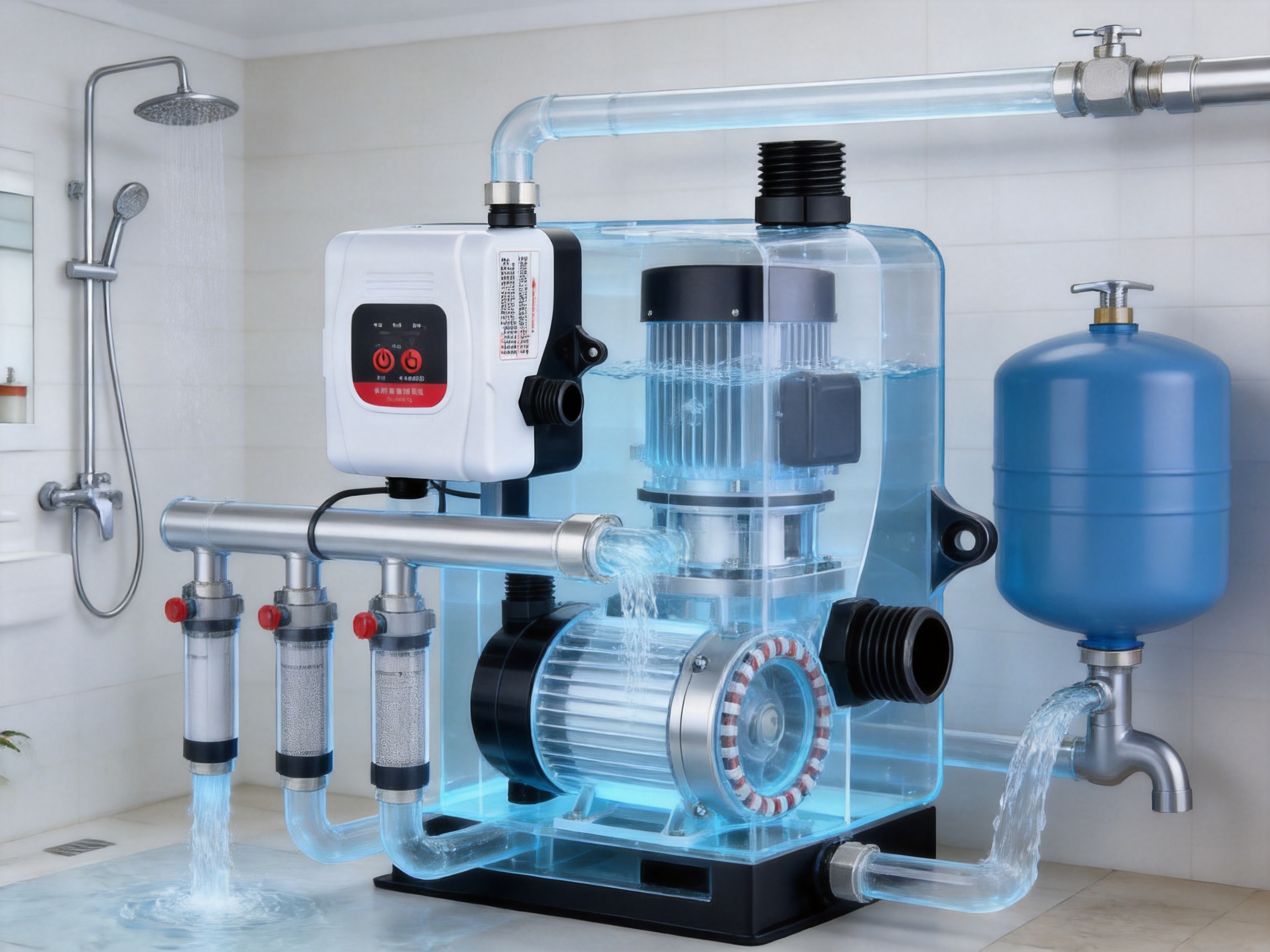
The intelligent variable frequency control system is designed to monitor water demand and regulate the motor accordingly. When a user opens an outlet, the controller recognizes the need for water and starts the pump. As demand changes, the controller adjusts the speed. When the outlet is closed and the system reaches its required condition, the pump stops automatically.
This type of control can improve pressure stability in several ways. First, it allows the pump to match output more closely with actual demand. Second, it reduces the need for abrupt full-speed operation. Third, it supports automatic control without requiring the user to operate the pump manually.
3.1 Stable Pressure at Different Outlets
Stable pressure is important because water users expect a tap or shower to behave consistently. Sudden changes in pump speed can create uncomfortable pressure variation. A controlled variable frequency system can help reduce these variations by adjusting the motor output progressively.
The actual pressure result depends on the complete system. Pipe diameter, vertical lift, filters, valves, storage tanks, outlet restrictions, and simultaneous water use all affect performance. The pump should therefore be selected and installed as part of a complete hydraulic design rather than treated as an isolated component.
For a compact 24V installation, the 19-meter listed head provides a useful reference for planning. However, maximum head is not the same as operating flow at every point. Buyers should consult the manufacturer or distributor for a detailed performance curve when the application requires precise pressure and flow verification.
3.2 Automatic Start and Stop
Automatic operation makes the pump convenient for regular household use. A user can open a faucet or start a shower without first locating a separate pump switch. When the water demand ends, the pump can stop, reducing energy consumption and avoiding unnecessary running time.
Automatic start-stop is also valuable in recreational vehicles and boats, where users may want a compact water system that behaves similarly to a household supply. It can reduce the need for complicated operating instructions and make the system easier to use for different occupants.
Automatic control should not be confused with complete system protection under every possible condition. Proper inlet water supply, correct electrical connection, suitable plumbing, and compliance with the manufacturer’s installation instructions remain necessary. Dry-running conditions, blocked lines, excessive restriction, or incorrect wiring may affect pump performance and service life.
4. Advantages Compared with Conventional Booster Pumps
The product’s competitive advantages are based on its integrated technology rather than on one isolated feature. The key comparison is between a 24V intelligent variable frequency system and a conventional fixed-speed booster pump designed for basic pressure assistance.
| Feature | 24V Intelligent Booster Pump | Conventional Fixed-Speed Pump | Practical Benefit |
| Motor technology | Permanent magnet synchronous motor | Usually fixed-speed motor design | Efficient, compact, and responsive operation |
| Speed control | Variable frequency adjustment | Generally fixed operating speed | Better matching of output to demand |
| Operation | Automatic start and stop | Manual or basic pressure-switch control | Greater convenience for daily use |
| Noise profile | Designed for low-noise operation | May produce stronger start-up and running noise | Better suitability for indoor and mobile systems |
| Electrical configuration | 24V low-voltage model available | Often dependent on standard mains supply | Useful for vehicles, boats, batteries, and remote systems |
| Pressure behavior | Speed adjusts according to water demand | Pressure may fluctuate more noticeably | More consistent water delivery |
| Product range | 24V and higher-power 220V options in the series | May require a different supplier for other configurations | Simplified sourcing for distributors and projects |
A major advantage of the 24V configuration is installation flexibility. Many remote and mobile systems already use 24V battery banks, solar-assisted electrical systems, control panels, or vehicle electrical architectures. A 24V pump can reduce the need for a separate inverter in applications where low-voltage DC power is already available.
Low-voltage compatibility can also support backup water supply systems. During a power interruption, a properly designed battery system may continue to operate essential water services. The actual backup duration will depend on battery capacity, inverter or direct-current compatibility, pump duty cycle, cable size, and the number of outlets in use.
Another competitive advantage is quietness. A pump may have good hydraulic specifications but still be unsuitable for a bedroom, vehicle, or compact cabin if it produces excessive noise. The silent operating design addresses this practical concern directly. In many user environments, perceived comfort can be as important as maximum head or flow.
The variable frequency function also helps distinguish the pump from low-cost fixed-speed alternatives. A basic pump may have a lower purchase price, but it may consume more power in certain operating conditions, create larger pressure changes, and require more manual control. The intelligent design offers a more complete solution for buyers who value convenience and operating quality.
5. Applications for the 24V Model
The 24V version is intended for applications where moderate water pressure assistance is needed and a low-voltage electrical source is preferred. It is particularly suitable for systems with changing water demand and users who want automatic, quiet operation.
5.1 Household Water Supply
In a house or apartment, the pump can assist areas where municipal pressure is weak or inconsistent. Possible uses include supplying upper floors, improving shower pressure, supporting kitchen and bathroom outlets, or stabilizing water delivery from a storage tank.
Before installation, the user should confirm that the pump’s listed head and flow are appropriate for the building layout. Long pipe runs, multiple floors, narrow tubing, filters, and restrictive valves can reduce available pressure. A professional installer should assess the system when several outlets may operate at the same time.
5.2 Recreational Vehicles and Mobile Homes
Recreational vehicles require compact equipment that can operate efficiently and quietly in a limited interior space. A 24V booster pump can be integrated into selected vehicle water systems, particularly where a 24V battery bank is already available.
The pump’s automatic start-stop function is convenient for travelers. Water can be used at a sink, shower, or toilet without manually switching the pump on and off. Low-noise operation is also valuable because the pump may be installed near sleeping or living areas.
Vehicle installations should include suitable vibration isolation, secure pipe connections, appropriate electrical protection, and protection from freezing temperatures. The pump should be mounted in a location that allows inspection and maintenance while shielding it from unnecessary water exposure and road vibration.
5.3 Boats and Marine Utility Systems
Small boats and marine cabins often rely on compact pressurized water systems. The 24V electrical configuration may be compatible with marine battery systems, subject to the specific electrical design and installation requirements of the vessel.
Marine users should pay particular attention to corrosion protection, ventilation, moisture management, cable routing, and secure mounting. The pump should be used only in an application that meets the manufacturer’s environmental and electrical requirements. Saltwater compatibility should not be assumed unless it has been specifically confirmed.
5.4 Remote Cabins and Off-Grid Installations
Remote cabins, agricultural shelters, and off-grid homes may obtain water from storage tanks, wells, rainwater systems, or local reservoirs. These systems often use batteries, solar power, or other independent energy sources. A 24V booster pump can be a practical component when the rest of the system is designed for the same voltage.
Variable frequency control is helpful in off-grid applications because water use may vary widely. The pump can operate according to demand instead of running continuously at maximum speed. This can help users manage available energy, although battery and solar sizing must be based on the complete expected duty cycle.
5.5 Small Irrigation and Utility Systems
The pump can also be considered for selected garden irrigation, greenhouse, landscape, and utility-water systems. It may provide pressure assistance for sprinklers, hoses, drip systems, or small distribution networks, provided that the required flow, pressure, and water quality fall within the pump’s operating range.
Irrigation applications should account for filter selection, emitter resistance, elevation differences, and the number of outlets operating simultaneously. Dirt, sand, plant material, and other suspended particles may affect pump performance, so an appropriate filtration and water-treatment strategy should be evaluated.
6. Manufacturing Strengths and Product Development Capability
The performance of a pump is influenced not only by its design but also by the manufacturer’s ability to organize production, manage materials, control assembly, test finished products, and support customers after delivery. Zhejiang ZhenTai Mechanical and Electrical Co., Ltd. has developed a product portfolio covering more than 90 products across 10 series. This broad range includes floating aerators, impeller aerators, water wheel aerators, water pumps, and other equipment used in aquaculture, irrigation, drainage, environmental protection, and household water supply.
A diversified product portfolio can provide several manufacturing advantages. Pump technologies often share common knowledge in motor selection, impeller design, sealing, electrical control, casting or molded components, assembly, and performance testing. Experience across multiple equipment categories can support the development of products for different operating environments.
The company is located in Wenling, Zhejiang Province, an area known for mechanical and electrical manufacturing. Its factory base supports access to industrial supply chains, engineering services, component suppliers, and technical labor. For overseas buyers, this industrial environment can be valuable when sourcing pumps in different power classes, connection sizes, and application categories.
6.1 Integrated Product Development
The 24V intelligent booster pump requires coordination between mechanical, electrical, hydraulic, and control-system design. The motor must provide sufficient torque, the hydraulic section must deliver useful pressure and flow, the control system must respond appropriately to demand, and the housing must support safe and reliable operation.
Manufacturing experience with both aeration equipment and water pumps can help a supplier understand different fluid-handling requirements. Aerators and air blowers focus on air transfer and circulation, while water pumps focus on liquid movement and pressure generation. Both product groups require attention to motor durability, sealing, noise, heat dissipation, and operating stability.
For distributors and OEM customers, a broad product platform can simplify product sourcing. Instead of purchasing every pump category from a different supplier, a buyer may be able to coordinate water pumps, submersible pumps, air blowers, and aquaculture aerators through one manufacturing partner. This can reduce communication complexity and support more consistent packaging, documentation, and commercial coordination.
6.2 Production Process Considerations
A reliable booster pump production process normally begins with incoming material and component verification. Motor parts, permanent magnets, electrical components, seals, fasteners, housings, impellers, connectors, and control assemblies should be checked against the applicable design and procurement requirements.
Motor assembly requires careful attention to rotor and stator alignment, bearing installation, winding quality, insulation, magnetic component positioning, and balance. Proper assembly helps reduce vibration and supports smooth operation. For a silent pump, mechanical balance and secure component fit are particularly important because small sources of vibration may become noticeable in quiet indoor environments.
The hydraulic assembly must also be completed carefully. The pump body, impeller or internal flow components, inlet and outlet passages, seals, and connection points need to be assembled with suitable accuracy. Poor sealing can cause leakage, air entry, pressure loss, or premature component deterioration.
Control-system assembly involves the integration of the variable frequency controller, sensors or detection elements, wiring, connectors, and protective components. Correct electrical connection and functional verification are essential. The controller must respond to demand, adjust operating speed, and complete automatic stop behavior according to the intended design.
Final testing may include electrical safety checks, start-stop verification, noise observation, vibration checks, pressure and flow evaluation, leakage inspection, and visual quality review. The precise test sequence depends on the manufacturer’s internal procedures and the model configuration. Buyers requiring specific inspection standards should confirm them with the supplier before placing an order.
6.3 Quality-Oriented Assembly and Testing
For a pump intended to provide stable water pressure, quality control should extend beyond appearance. A product may look acceptable while still having an electrical, hydraulic, or control problem. Functional testing is therefore important for confirming that the finished unit performs as intended.
Testing should verify that the pump starts when a suitable demand signal is present, operates smoothly at the expected speed range, and stops when demand ends. Hydraulic performance should be checked against the product’s listed operating data. Electrical input and motor behavior should also be reviewed for abnormal heating, vibration, or sound.
Because the product is designed for quiet operation, noise evaluation deserves particular attention. A consistent test method allows the manufacturer to identify unusual bearing noise, rotor imbalance, loose components, water turbulence, or control-related sound. Installation conditions will influence field noise, but factory-level inspection can help reduce avoidable variation.
7. Installation and System Design Guidance
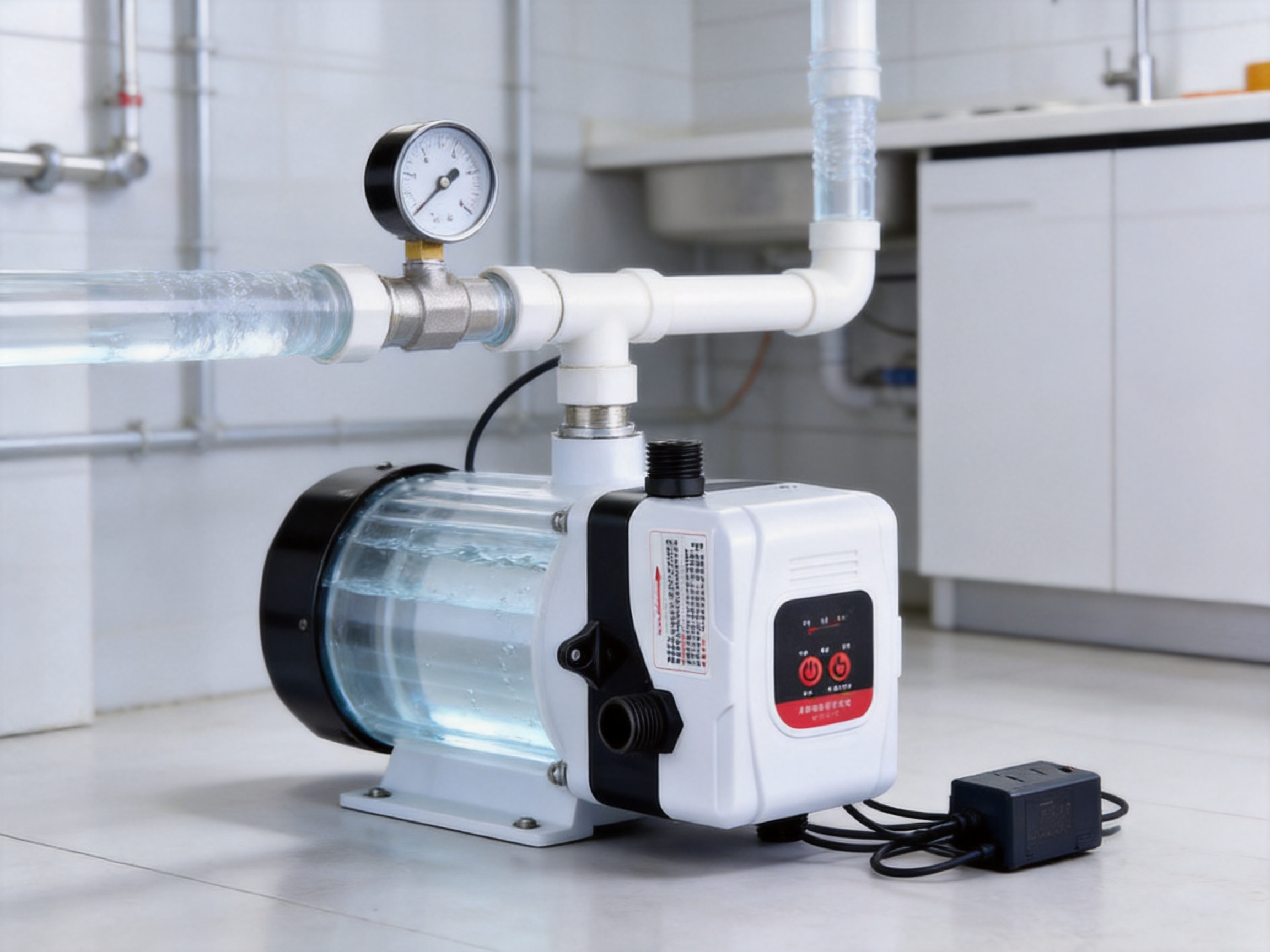
Correct installation is essential for achieving the expected benefits of the intelligent booster pump. The unit should be installed in a suitable indoor or sheltered location, with adequate protection from rain, flooding, excessive dust, direct sunlight, and mechanical damage. The installation area should also allow access for inspection and service.
The water inlet and outlet connections must be properly secured. Loose connections can introduce air, create leaks, reduce pressure, or cause unwanted vibration. Pipework should be supported independently where necessary so that excessive mechanical load is not transferred to the pump housing or connection ports.
The pump should be connected to a stable and compatible power supply. For the 24V model, the electrical system must provide the correct voltage and sufficient current capacity. Cable size should be selected according to cable length, expected current, voltage drop, installation environment, and applicable electrical requirements.
Where a battery is used, the battery bank and charging system should be sized for the pump’s operating cycle. A nominal 24V battery system may not remain at exactly 24V under all conditions, so the operating range and protection requirements should be confirmed before installation. Fuses, disconnects, grounding, and other protective devices should be selected by a qualified technician.
7.1 Inlet Conditions
The pump inlet should receive an adequate water supply. If the inlet is restricted, partially blocked, or exposed to air, the pump may fail to deliver the intended pressure and flow. An unsuitable inlet arrangement can also increase noise and place additional stress on internal components.
Filters may be required when the water contains particles. However, a filter that is too small, too fine, or poorly maintained can create excessive pressure loss. The filter should be selected to balance water cleanliness with acceptable inlet resistance.
7.2 Outlet and Pressure Management
The discharge side should be designed with appropriate pipe diameter, valves, fittings, and outlets. Narrow piping can increase friction loss and reduce useful pressure. Long runs and multiple bends should be considered during system planning.
When several outlets operate at once, the total demand may approach or exceed the pump’s practical capacity. Users should compare the combined flow requirement with the pump’s performance data. If greater flow or head is needed, one of the higher-power models in the product family may be more suitable.
7.3 Mounting and Noise Reduction
Even a low-noise pump can become loud if it is mounted directly to a thin panel, loose bracket, or resonant cabinet. A rigid and stable mounting surface, combined with suitable vibration-isolation measures where appropriate, can help reduce transmitted noise.
Pipework should not be allowed to strike walls or cabinets when the pump starts and stops. Flexible connectors may be useful in some systems, provided that they are rated for the application and installed without creating excessive restriction.
8. Maintenance and Operating Practices
Routine maintenance helps protect pump performance and extend service life. Users should periodically inspect the pump, electrical connections, water connections, filters, valves, and surrounding area. Any sign of leakage, unusual sound, abnormal vibration, repeated cycling, or reduced pressure should be investigated promptly.
Filters should be cleaned according to water quality and usage conditions. A blocked filter can reduce inlet flow and force the pump to work under unfavorable conditions. In systems using stored water, the tank should also be checked for sediment, biological growth, and other contamination that could reach the pump.
The pump should not be allowed to operate without an adequate water supply unless the manufacturer has specifically confirmed protection against dry running. If the system may run empty, an appropriate protective arrangement should be considered. The correct protection method depends on the installation, controller functions, tank design, and operating environment.
In seasonal or cold-weather installations, users should protect the pump and pipework from freezing. Frozen water can expand and damage housings, seals, fittings, and connected plumbing. Mobile systems should be drained or winterized according to their operating instructions.
Electrical connections should be kept clean, dry, secure, and protected against accidental short circuits. A qualified professional should handle any repair involving motor wiring, controller components, insulation, or internal electrical parts.
9. Selecting the Correct Model
The 24V ZTDC24V model is listed at 100 W, with a 19-meter head, 1.9 cubic meters per hour flow, and a 20 mm caliber. It is the natural choice when low-voltage compatibility, compact installation, and moderate water-pressure assistance are the main priorities.
The 220V 400 W version is listed with a 35-meter head and 2.7 cubic meters per hour flow through a 25 mm caliber. It may be more appropriate for larger household systems, higher vertical lift, or installations with greater pressure requirements, provided that the available power supply is compatible.
The 220V 600 W version is listed with the same 35-meter head and a higher flow rate of 3.5 cubic meters per hour. This option may serve applications requiring greater water volume or more simultaneous outlets.
Model selection should consider more than motor power. Buyers should evaluate the required pressure, expected flow, pipe length, elevation, water source, voltage, duty cycle, ambient conditions, noise expectations, connection size, and installation space.
| Selection Question | Why It Matters | Information to Confirm |
| What power source is available? | Determines whether the 24V or 220V version is suitable | Voltage, current capacity, battery or mains arrangement |
| How much pressure is required? | Determines the necessary head and system configuration | Vertical lift, outlet pressure, pipe resistance |
| What flow is needed? | Ensures the pump can serve the intended outlets | Individual and simultaneous outlet demand |
| Where will the pump be installed? | Affects noise, protection, access, and mounting | Indoor, sheltered, vehicle, boat, utility room, or remote site |
| What is the water quality? | Influences filtration and material requirements | Clean water, sediment, minerals, salt exposure, temperature |
| How often will it operate? | Influences energy use and maintenance planning | Intermittent, frequent cycling, or extended daily operation |
10. Value for Distributors, OEM Buyers, and Project Customers
For distributors, the product offers a clear marketing position: a quiet, intelligent, low-voltage booster pump using permanent magnet motor technology. This positioning can appeal to household water equipment dealers, RV suppliers, marine equipment distributors, solar-system integrators, plumbing wholesalers, and agricultural utility suppliers.
The pump’s features are easy to communicate to end users. Automatic start and stop operation addresses convenience. Variable frequency control addresses pressure stability and energy-conscious operation. Permanent magnet motor technology addresses efficiency and compact performance. Low-noise design addresses comfort. The 24V format addresses mobile and independent power systems.
OEM customers may also benefit from integrating the pump into a broader water-supply product. Potential combinations include compact water cabinets, vehicle water modules, cabin utility systems, tank-and-pump packages, irrigation kits, and backup water units. The appropriate integration depends on the customer’s technical requirements and should be confirmed with the manufacturer.
The manufacturer’s broader product capabilities can support buyers who need more than one type of fluid-handling equipment. In addition to water pumps, the company supplies aerators, submersible pumps, and air blowers. This may be especially useful for aquaculture and environmental projects that require both water circulation and air transfer equipment.
OEM and ODM cooperation can involve product configuration, labels, packaging, documentation, electrical requirements, connection standards, and market-specific commercial needs. Customers should provide detailed specifications early in the project so that the supplier can evaluate feasibility, tooling, testing, packaging, and production scheduling.
11. Why Manufacturing Location and Experience Matter
Wenling, Zhejiang Province, is an important manufacturing region for pumps and mechanical-electrical equipment. A supplier operating within an established industrial cluster can often access specialized component suppliers, production services, machining resources, motor-related expertise, and logistics channels.
For international buyers, manufacturing experience may reduce the risks associated with purchasing technically complex equipment. A supplier that understands pumps across household, agricultural, aquaculture, and drainage applications is better positioned to discuss application differences, performance expectations, and product selection.
Zhejiang ZhenTai Mechanical and Electrical Co., Ltd. was established in 2018 and has developed products for household water supply, aquaculture, fish pond aeration, farmland irrigation, foundation drainage, environmental protection, chemical industries, ecological landscape lakes, and flood control and drainage. These fields involve different requirements for pressure, flow, operating duration, environmental exposure, and equipment configuration.
The company emphasizes quality, integrity, technological innovation, reliable products, customized OEM/ODM services, and professional technical support. For buyers, the practical importance of these commitments should be evaluated through product documentation, sample testing, communication quality, inspection arrangements, warranty terms, and after-sales support.
12. Responsible Performance Claims
Performance claims should always be interpreted in relation to operating conditions. The listed 19-meter head and 1.9 cubic meters per hour flow for the 24V model are useful selection references, but pump performance is not identical at every point in the operating range. As pressure increases, available flow may change. As pipe resistance increases, delivered pressure and flow may decrease.
Noise claims should also be considered within the context of installation. Pump mounting, pipe vibration, water turbulence, air in the inlet, and surrounding surfaces can all influence the sound heard by users. A correct installation is necessary to obtain the best result from the quiet operating design.
Energy efficiency depends on the complete duty cycle. A permanent magnet variable frequency motor can provide an efficient operating platform, but actual consumption depends on run time, pressure demand, speed, water resistance, voltage quality, and system design. Buyers should request detailed technical data when energy calculations are required for a project.
These considerations do not weaken the value of the product. Instead, they help users select and install the pump realistically. A well-matched pump operating in a properly designed system can deliver better comfort, efficiency, and reliability than an oversized or poorly installed alternative.
13. Frequently Asked Questions
Q1: What is the main purpose of this pump?
The pump is designed to boost water pressure and provide a more stable water supply. It is suitable for selected household, mobile, recreational, remote, and utility water systems where automatic operation and quiet performance are important.
Q2: What does the 24V rating mean?
The 24V rating identifies the electrical configuration of the model. It is suitable for systems designed around a compatible 24V power source, such as selected battery, vehicle, marine, or off-grid installations. The power supply must provide the correct voltage and adequate current capacity.
Q3: Does the pump run continuously?
No. The intelligent control system is designed for automatic start and stop operation. The pump starts when water demand is detected and stops when demand ends, subject to correct installation and operating conditions.
Q4: How does variable frequency control help?
Variable frequency control allows the motor speed to change according to water demand. This can support more stable pressure, smoother operation, lower noise, and more efficient use of energy compared with a pump that always runs at one fixed speed.
Q5: Is the pump suitable for an RV?
The 24V configuration and low-noise design make it a potential choice for selected RV water systems. The installation must be checked for electrical compatibility, available space, water-system pressure, vibration, and protection from moisture and freezing.
Q6: Can it be used on a boat?
It may be considered for some boat water systems where a compatible 24V supply is available. Marine installation requires attention to moisture, corrosion, secure mounting, electrical protection, and the specific water being pumped. Saltwater compatibility should be confirmed before use.
Q7: What is the listed performance of the 24V model?
The ZTDC24V model is listed at 100 W, with a 19-meter head, 1.9 cubic meters per hour flow, and a 20 mm caliber. Actual performance depends on system resistance, water demand, installation conditions, and the pump’s operating point.
Q8: Are higher-power versions available?
Yes. The listed product family also includes 220V versions rated at 400 W and 600 W. Both are listed with a 35-meter head and a 25 mm caliber. Their listed flow rates are 2.7 and 3.5 cubic meters per hour respectively.
Q9: Is the pump completely silent?
No mechanical pump can be expected to produce absolutely no sound. This product is designed for low-noise operation, but the final sound level depends on mounting, pipework, water conditions, motor speed, and the surrounding structure.
Q10: Can the pump handle dirty water?
The available product information describes it as a water booster pump but does not establish unrestricted dirty-water or abrasive-fluid capability. Users should confirm water quality limits, filtration requirements, temperature limits, and material compatibility with the supplier before handling water containing sediment, chemicals, or salt.
Q11: What should be checked before installation?
Users should check the power supply, required pressure, expected flow, inlet-water availability, pipe sizes, connection security, mounting location, protection from weather, filter arrangement, and accessibility for maintenance.
Q12: Does the company support OEM and ODM projects?
The company states that it provides customized OEM/ODM services for global customers. Buyers should discuss labels, packaging, documentation, electrical configurations, connection requirements, testing, minimum order quantities, and production schedules directly with the manufacturer.
Q13: What industries does the manufacturer serve?
The company serves applications including aquaculture, fish pond aeration, farmland irrigation, building foundation drainage, environmental protection, chemical industries, household water supply, ecological landscape lakes, and flood control and drainage.
Q14: How can a distributor choose between the 24V and 220V versions?
The choice depends on the available power supply, required head, required flow, installation environment, and project design. The 24V model is more suitable for compatible low-voltage systems, while the higher-power 220V models may serve applications requiring greater output.
Q15: Where should buyers obtain detailed technical confirmation?
Buyers should contact the manufacturer or authorized sales representative for performance curves, operating limits, electrical details, installation instructions, warranty information, inspection requirements, and application-specific recommendations.
14. Conclusion
The 24V intelligent permanent magnet variable frequency silent booster pump offers a practical combination of low-voltage compatibility, efficient motor technology, automatic operation, adjustable speed, and quiet performance. Its 100 W configuration, 19-meter listed head, 1.9 cubic meters per hour listed flow, and 20 mm caliber make it suitable for a range of compact water-pressure applications when the system requirements are properly matched.
Its strongest advantage over conventional fixed-speed booster pumps is the integration of several user-focused technologies. The permanent magnet synchronous motor supports efficient and powerful operation. Variable frequency control enables the pump to respond to changing water demand. Automatic start and stop operation improves convenience. The low-noise design makes the product more appropriate for homes, vehicles, cabins, and other spaces where operating comfort matters.
The manufacturer’s wider experience in aerators, air blowers, submersible pumps, and water pumps adds value for distributors, OEM customers, and project buyers seeking a broader fluid-handling equipment supplier. Its product range, Chinese manufacturing base, technical focus, and stated OEM/ODM capability create opportunities for customized sourcing and long-term cooperation.
As with any pump, the best results depend on correct selection, proper installation, suitable water conditions, reliable electrical supply, and regular maintenance. When these factors are addressed, the intelligent 24V booster pump can provide a quiet and responsive solution for stable water pressure in household, mobile, recreational, remote, and selected utility systems.
References
1. Product specification information supplied for the 24V Intelligent Permanent Magnet Variable Frequency Silent Booster Pump, model ZTDC24V.
2. Product specification information supplied for the ZTDC220V 400 W and 600 W water pump configurations.
3. Manufacturer information supplied for Zhejiang ZhenTai Mechanical and Electrical Co., Ltd., including company history, product categories, application fields, and OEM/ODM capabilities.
4. General engineering principles for centrifugal and pressure-boosting pump selection, including the relationship between head, flow, pipe resistance, and system operating conditions.
5. General motor engineering principles concerning permanent magnet synchronous motors, power factor, efficiency, variable frequency control, and speed regulation.
6. General water-system installation practices concerning pump mounting, pipe support, filtration, electrical protection, pressure management, and maintenance.