 English
 Español
 Indonesia
DSU Series High-Flow Electric Pump
Reliable water transfer is essential in agriculture, drainage, construction, aquaculture, and general water-supply applications. A suitable pump must move sufficient water, maintain stable pressure, operate efficiently, and remain practical to install and transport. The DSU Series high-flow electric pump is designed to meet these requirements through a combination of aluminum construction, a flow-channel impeller, a flow-channel volute, self-priming operation, and a compact structure.
Available in DSU-50 and DSU-80 configurations, the series provides maximum flow rates of 25 m³/h and 50 m³/h respectively, with a maximum head of 28 meters and a suction capability of up to 8 meters. These specifications make the pump appropriate for irrigation water transfer, agricultural water supply, drainage work, tank filling, and other applications where a large volume of water must be moved within a practical operating range.
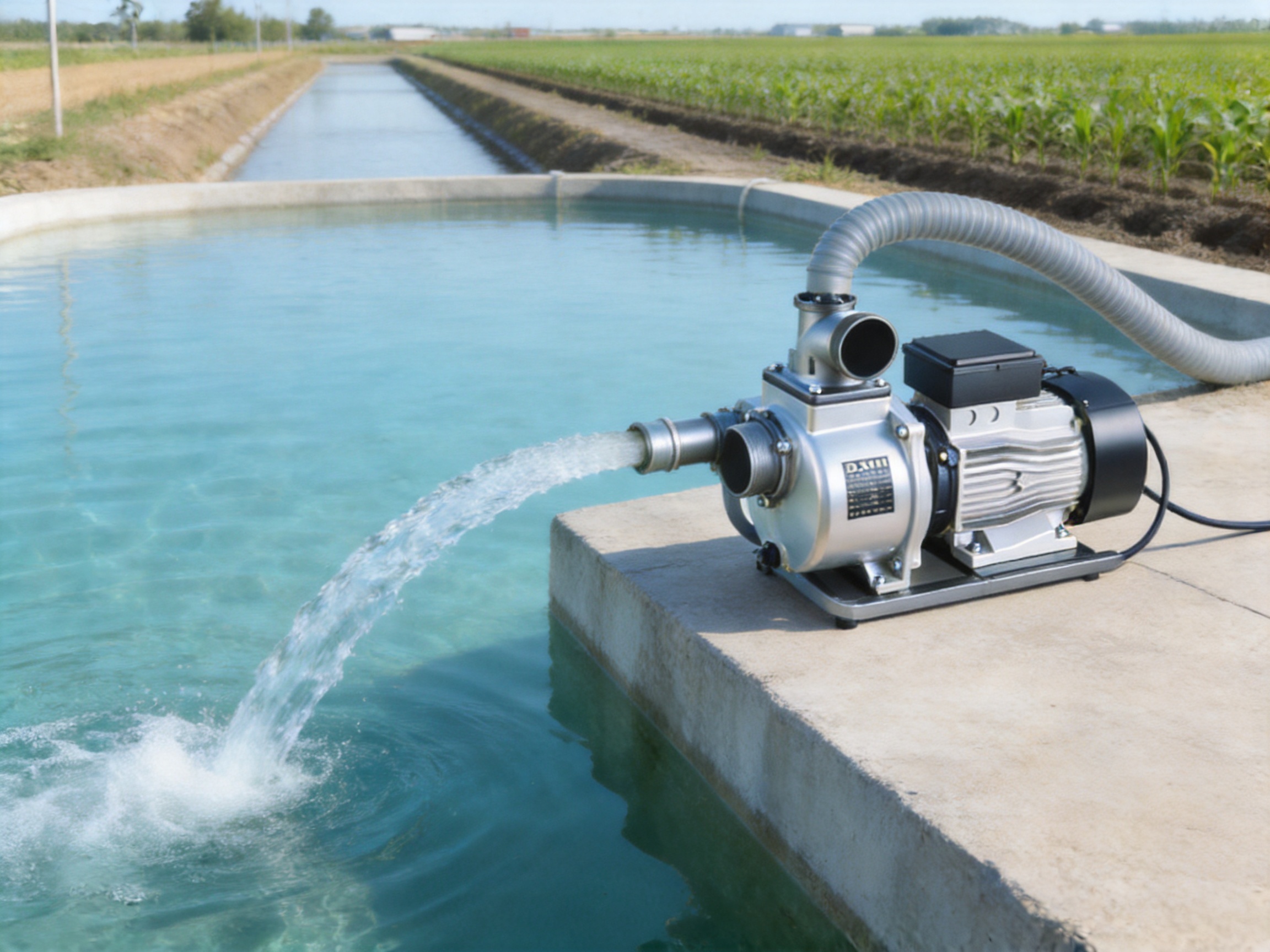
Unlike a traditional submersible pump, the DSU Series does not need to be placed directly underwater during normal operation. Its self-priming design allows the pump to remain in a stable, accessible position while connected to an inlet pipe and an outlet pipeline. This arrangement can simplify inspection, electrical connection, maintenance, and seasonal storage.
Product Overview
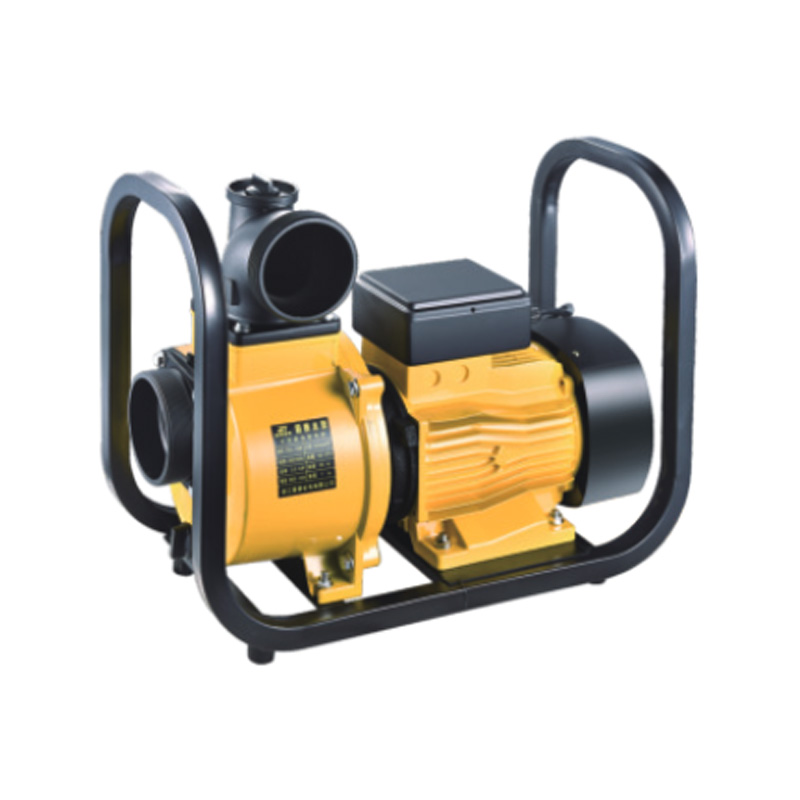
The DSU Series high-flow electric pump is built around a straightforward centrifugal pumping concept. An electric motor drives the impeller, the impeller transfers energy to the water, and the volute guides the moving water toward the discharge outlet. The flow-channel structure is intended to support high-volume movement while maintaining stable hydraulic performance.
The motor housing and pump casing are made from aluminum alloy. This material selection contributes to a lightweight product structure compared with many conventional iron-bodied pumps of similar general application. Lower equipment weight can make a noticeable difference when the pump must be moved between fields, drainage locations, construction sites, storage areas, or temporary water-transfer stations.
The pump is designed for self-priming operation, high flow, high head, and low power consumption. These characteristics are especially valuable for agricultural users and wholesalers who need equipment that can be deployed quickly without the complexity of permanent installation.
The DSU Series is supplied in two primary models. The DSU-50 uses a 50-size inlet and outlet and provides a maximum displacement of 25 m³/h. The DSU-80 uses an 80-size inlet and outlet and provides a maximum displacement of 50 m³/h. Both models have a maximum head of 28 meters, a maximum suction height of 8 meters, a rated speed of 2,900 rpm, and a frequency of 50 Hz.
| Specification | DSU-50 | DSU-80 |
|---|---|---|
| Inlet and outlet size | 50 | 80 |
| Maximum displacement Q.max | 25 m³/h | 50 m³/h |
| Maximum lift H.max | 28 m | 28 m |
| Maximum suction | 8 m | 8 m |
| Power | 2.2 kW | 2.5 kW |
| Speed | 2,900 rpm | 2,900 rpm |
| Voltage | 220/380 V | 220/380 V |
| Frequency | 50 Hz | 50 Hz |
High-Flow Performance for Practical Water Transfer
The primary advantage of the DSU Series is its ability to handle a large water volume in relation to its compact structure and moderate power range. The DSU-50 reaches a maximum flow of 25 m³/h, while the DSU-80 reaches up to 50 m³/h. For users filling storage tanks, supplying irrigation channels, transferring water between ponds, or removing accumulated water, this capacity can reduce the time required for routine operations.
High flow is not simply a matter of selecting the largest possible pump. The pump must also provide a useful balance between flow and head. Both DSU models are rated for a maximum lift of 28 meters, giving users flexibility when water must be moved through a vertical elevation or along a pipeline with resistance. The actual flow achieved in a specific installation will depend on pipe length, pipe diameter, bends, valves, elevation, water conditions, and other system factors.
The 8-meter suction specification is useful for installations where the pump is positioned above the water source. This arrangement can be convenient for irrigation reservoirs, open tanks, farm ponds, drainage pits, and temporary water-transfer points. The pump can remain on dry ground while the inlet hose or pipe extends into the water source.
Compared with a basic low-head transfer pump, the DSU Series provides a stronger operating range for applications that combine considerable water volume with moderate elevation. Compared with many small portable pumps, its larger flow-channel configuration gives users more capacity for agricultural and commercial work. The result is a versatile pump family rather than a single-purpose household unit.
Understanding Maximum Flow and Maximum Head
Maximum flow and maximum head are not normally achieved at the same operating point. Maximum flow generally refers to the output under low resistance, while maximum head refers to the pressure capability under a much more restricted flow condition. Buyers should therefore treat the listed values as performance limits and evaluate the complete piping system before selecting a model.
For short pipelines with few bends and a low elevation difference, the DSU-50 may provide an appropriate balance of capacity and energy use. For applications requiring a larger delivery volume or a larger pipe connection, the DSU-80 offers twice the listed maximum displacement. A professional system designer should consider the required flow rate, total dynamic head, pipe friction, water source level, and operating schedule before finalizing the selection.
Aluminum Alloy Construction and Portable Design
The DSU Series uses an aluminum alloy motor housing and an aluminum alloy pump casing. Aluminum alloy is valued in pump construction because it can provide a useful combination of light weight, structural strength, and practical corrosion resistance in many ordinary water-transfer environments.
A lightweight structure offers direct operational benefits. Agricultural workers may need to move pumps across uneven ground, reposition equipment during irrigation, or transport equipment between separate fields. Drainage contractors may have to install a pump at changing locations. A pump that is easier to lift and carry can reduce handling time and improve deployment efficiency.
The aluminum casing also supports a compact product concept. Compared with heavier cast-iron alternatives, an aluminum-bodied pump can be more convenient for temporary installations and mobile use. This does not eliminate the need for proper mounting. Even a lightweight pump should be placed on a stable, level surface where vibration, pipe strain, water exposure, and accidental movement can be controlled.
Material selection should always be matched to the liquid being pumped. The DSU Series is presented as a water-transfer pump for applications such as irrigation, drainage, and farm water supply. Users should confirm compatibility before pumping abrasive slurries, highly corrosive liquids, chemically treated water, seawater, or liquids containing large solids. Appropriate inlet filtration and operating practices can help protect the hydraulic components.
Benefits for Mobile and Temporary Installations
Many water-transfer tasks are seasonal or temporary. Irrigation layouts change as crops develop, drainage points change after rainfall, and construction sites progress from one area to another. A pump that can be moved without specialized lifting equipment offers a practical advantage in these environments.
The combination of aluminum construction, external installation, and self-priming operation allows the DSU Series to function as a flexible field tool. Operators can position the pump outside the water source, connect a suction hose, route the discharge line to the destination, and remove the unit when the work is complete. This is different from a fixed pump station, but it is highly useful when mobility and quick setup are more important than permanent automation.
Flow-Channel Impeller and Volute Structure
The DSU Series adopts a flow-channel impeller and a flow-channel volute design. These components are central to the pump’s hydraulic performance. The impeller rotates inside the pump casing and accelerates the water, while the volute collects and directs the flow toward the discharge passage.
A flow-channel structure is suitable for applications requiring substantial water movement. It provides a defined hydraulic route through the pump and supports the series’ high-flow positioning. The relationship between impeller geometry, volute shape, casing passage, and outlet size affects the pump’s ability to move water efficiently and consistently.
The DSU-50 and DSU-80 use different inlet and outlet sizes to accommodate different flow requirements. The larger DSU-80 passage is associated with a maximum displacement of 50 m³/h, while the DSU-50 is rated at 25 m³/h. Correct pipe sizing is important because an undersized inlet or discharge line may increase resistance, reduce actual flow, and place unnecessary demand on the pump.
Users should also prevent oversized solids, debris, stones, crop residue, and foreign materials from entering the suction line. A suitable strainer can help protect the impeller and flow passages. The strainer should be selected and maintained so that it provides protection without becoming excessively restrictive.
Stable Hydraulic Operation
Stable hydraulic performance is important for irrigation and water-transfer work. Sudden reductions in flow can interrupt field distribution, extend filling times, or reduce drainage progress. The DSU Series is designed around a defined impeller and volute arrangement that supports consistent movement when the pump is installed within its intended operating range.
Stable operation also depends on installation quality. The suction hose should be airtight, adequately supported, and appropriate for vacuum service. Loose connections on the suction side can allow air to enter the system and interfere with priming. The discharge pipe should be supported independently so that its weight does not pull on the pump casing or create stress at the connection.
Self-Priming Operation Without Submersion
One of the most useful characteristics of the DSU Series is self-priming operation. A self-priming pump is installed outside the water source rather than being lowered into the water like a traditional submersible pump. This can make the electrical system easier to access and can simplify routine inspection.
External installation offers several practical benefits. Operators can inspect the motor and casing without lifting the pump from a pond or pit. Electrical connections remain away from direct immersion. The pump can be placed under a protective cover or in a dedicated pump area. After use, the unit can be drained, cleaned, and stored in a controlled location.
Self-priming does not mean that every installation can operate without preparation. The pump and suction line must be installed according to the applicable operating instructions. Depending on the design and site arrangement, the pump may require initial filling or priming before the first start. The inlet line must remain airtight, and the suction height must remain within the specified 8-meter limit.
The pump should never be run dry. Water is important for hydraulic operation and may also help protect internal components from excessive heat or wear. Before starting, the operator should verify that the pump is correctly filled when required, the suction hose is submerged sufficiently, the inlet strainer is clear, and the discharge route is open.
Electrical Configuration and Energy Considerations
The DSU Series is designed for low power consumption in relation to its intended water-transfer performance. The DSU-50 is listed at 2.2 kW, while the DSU-80 is listed at 2.5 kW. Both models are rated at 2,900 rpm and 50 Hz.
The voltage specification is 220/380 V. Because electrical systems vary by country, site, and phase arrangement, buyers should confirm the required wiring configuration before ordering and installation. A qualified electrician should connect the pump according to the nameplate, local electrical codes, motor-protection requirements, and the available power supply.
Correct electrical protection is essential. A suitable circuit breaker, overload protection, grounding arrangement, and isolation switch can help reduce the risk of motor damage and improve operator safety. Cables should be selected for the motor rating, installation distance, environmental conditions, and voltage drop. Electrical equipment should be protected from rain, standing water, excessive humidity, and accidental impact.
Lower power consumption can contribute to reduced operating costs, but energy use depends on actual conditions. A pump working against excessive pipe resistance may consume energy without delivering the expected volume. Correct pipe sizing, regular maintenance, and operation near the intended performance range are important for achieving efficient results.
Choosing Between DSU-50 and DSU-80
The DSU-50 is a practical option for users requiring a maximum displacement of approximately 25 m³/h with a 50-size connection. It may suit smaller irrigation zones, moderate drainage tasks, tank transfer, and general farm water supply. Its 2.2 kW power rating can be attractive where electrical capacity and operating cost must be carefully managed.
The DSU-80 is intended for higher-volume transfer, with a maximum listed displacement of 50 m³/h and an 80-size inlet and outlet. It may be preferred for larger irrigation areas, faster reservoir filling, higher-capacity drainage, and commercial water-transfer work. Its 2.5 kW power rating provides a relatively modest increase in listed power compared with the larger maximum flow specification, although actual performance will depend on the system curve.
| Application consideration | Potentially suitable model | Reason |
|---|---|---|
| Moderate irrigation or transfer volume | DSU-50 | 25 m³/h maximum displacement and 50-size connections |
| Higher-volume agricultural transfer | DSU-80 | 50 m³/h maximum displacement and 80-size connections |
| Elevated delivery route | Either model, subject to calculation | Both are listed with a 28-meter maximum lift |
| Pump above an open water source | Either model, subject to installation limits | Both are listed with an 8-meter maximum suction |
| Portable seasonal use | Either model | Aluminum construction supports easier handling |
The correct choice should not be based on maximum flow alone. If the pipeline is too small for the DSU-80, the larger model may not deliver its full potential. Conversely, selecting the DSU-50 for a system that demands 50 m³/h may result in longer operating times or insufficient water delivery. Buyers should provide the supplier with the desired flow, pipe size, pipeline length, vertical elevation, liquid temperature, and operating conditions.
Advantages Compared with Common Alternative Pump Types
The DSU Series occupies a useful position between small domestic transfer pumps and heavier industrial pumping equipment. Its high-flow design offers more capacity than many basic household pumps, while its aluminum construction keeps the product practical for agricultural and mobile applications.
Compared with traditional submersible pumps, the DSU Series can be easier to inspect and retrieve because it remains outside the water source. Operators do not need to lift the motor from a pond or drainage pit for every inspection. The external design can also support simpler seasonal storage and reduce the exposure of the motor body to submerged conditions.
Compared with heavy cast-iron centrifugal pumps, the aluminum body can offer a more portable alternative. This may be important to small farms, maintenance teams, rental operators, and distributors serving customers who value mobility. The lower weight does not replace the need for durable installation, but it can improve handling efficiency.
Compared with low-head pumps, the DSU Series provides a listed maximum lift of 28 meters. This creates more flexibility where water must travel uphill or through a longer pipeline. However, buyers should still evaluate the complete hydraulic system rather than assuming that the maximum head represents normal flow performance.
Compared with poorly matched high-power pumps, the DSU Series offers a moderate power range of 2.2 to 2.5 kW for its stated applications. This can help users balance water-transfer capacity with available electrical infrastructure. The low-power-consumption design is particularly relevant where pumps operate regularly during irrigation seasons.
Practical Advantages for Agricultural Buyers
Agricultural buyers often need equipment that can perform multiple tasks. The same pump may be used for field irrigation, greenhouse supply, pond transfer, tank filling, drainage after heavy rain, and water circulation in farm facilities. The DSU Series supports this type of multi-purpose use when the water quality, pipe configuration, and required operating point remain within the pump’s design range.
The two-model range also makes inventory planning easier for wholesalers. A distributor can offer a moderate-capacity model and a higher-capacity model without maintaining a very large number of product variations. The shared series concept may simplify product training, spare-parts planning, sales documentation, and customer support.
For international buyers, the 220/380 V and 50 Hz specifications should be reviewed against local power standards. Regional electrical variations may require a different configuration or additional equipment. Clear technical communication before shipment is important for avoiding installation delays.
Manufacturing Strengths and Product Development Capability
The DSU Series is produced by Zhejiang ZhenTai Mechanical and Electrical Co., Ltd., a manufacturer located in Wenling, Zhejiang Province, China. Established in 2018, the company specializes in the research, development, and production of more than 90 products across 10 series. Its product range includes floating aerators, impeller aerators, water wheel aerators, water pumps, submersible pumps, and air blowers.
This broad product portfolio is relevant to the DSU Series because it reflects experience across multiple water-treatment and fluid-handling categories. A manufacturer serving aquaculture, irrigation, drainage, environmental protection, chemical industries, household water supply, landscape lakes, and flood-control applications must understand different flow requirements, installation conditions, and customer priorities.
The company’s stated focus on research and development, continuous technological innovation, quality, and reliable products supports the product-development foundation behind the DSU Series. The pump combines a practical mechanical architecture with specific material and hydraulic choices: aluminum alloy motor housing, aluminum alloy casing, flow-channel impeller, flow-channel volute, self-priming operation, and low power consumption.
Manufacturing Process Considerations
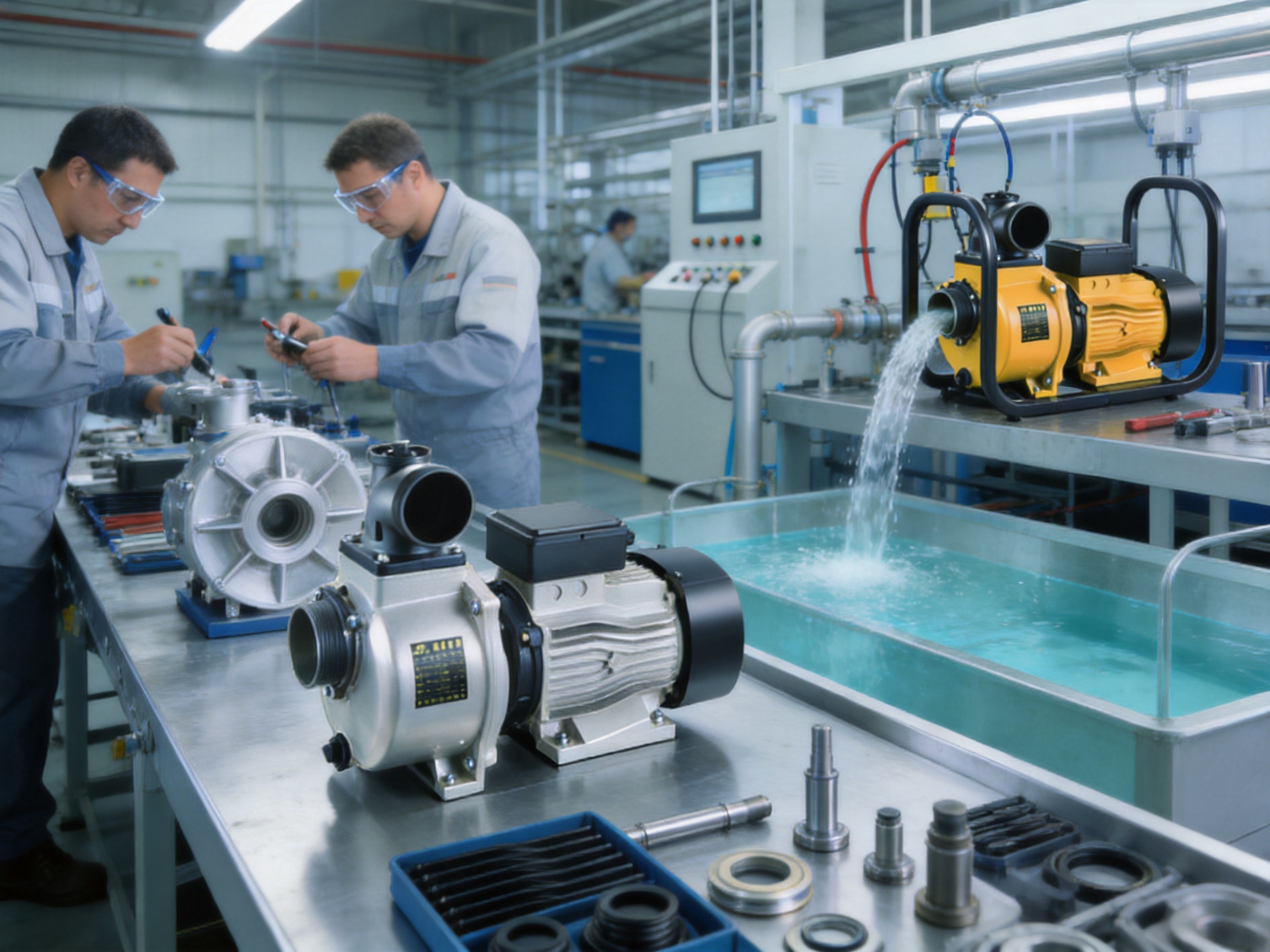
Although individual production procedures may vary by model and order, the DSU Series requires a coordinated manufacturing process. Aluminum alloy components must be formed to the required dimensions, machined where necessary, and inspected so that the motor housing, pump casing, impeller, shaft, seals, and connection points fit correctly.
Hydraulic consistency depends on dimensional control. The impeller and volute must work together as a matched flow passage. Inlet and outlet connections should be produced with dependable dimensional accuracy so that hoses, pipes, and fittings can be installed securely. Shaft alignment and bearing support are also important to smooth rotation and long-term operating reliability.
Motor assembly requires attention to winding quality, insulation, rotor balance, terminal connections, grounding, and protective components. A pump’s hydraulic performance cannot be separated from its motor performance. Stable speed is necessary for the impeller to produce consistent water movement, while appropriate electrical protection helps prevent avoidable failures.
Final assembly should include checks of fasteners, sealing surfaces, rotating components, electrical connections, and the pump’s overall structural condition. Functional testing can help identify leakage, abnormal vibration, unusual noise, poor priming, incorrect rotation, and other issues before shipment. These process stages are especially important for export products that may be transported over long distances and installed by customers in different countries.
Quality-Oriented Production
Quality in pump manufacturing is not limited to the appearance of the finished casing. It includes material consistency, dimensional accuracy, hydraulic behavior, motor reliability, sealing performance, electrical safety, packaging, and documentation. A quality-oriented manufacturer must connect these stages into a repeatable production system.
The company’s experience across more than 90 products and 10 series provides a platform for product coordination and manufacturing specialization. A diverse product range can support shared knowledge in motor production, aluminum component handling, pump assembly, electrical testing, packaging, and technical service. It also enables the manufacturer to respond to different customer applications without treating every project as an entirely new product.
For wholesalers and OEM buyers, manufacturing strength is also reflected in communication. Accurate product specifications, model identification, voltage confirmation, packaging requirements, spare-parts discussions, and order follow-up are essential parts of a successful supply relationship. ZhenTai states that it provides customized OEM/ODM services and professional technical support for customers worldwide, which can benefit buyers developing private-label or application-specific product programs.
Installation Guidance
Before operation, place the pump on a stable, level, and dry support. The installation area should provide enough space for inspection, ventilation, electrical isolation, and pipe connection. The pump should not be allowed to hang from its hoses or rest on an unstable surface.
Inspect the pump, motor, cable, inlet, outlet, and accessories before connection. Confirm that the selected model matches the required flow and pipe size. Check that the suction hose is suitable for negative pressure and that all joints are properly sealed. Air leakage on the inlet side is a common cause of priming difficulty.
Install an appropriate strainer at the suction end when the water source contains leaves, stones, crop residue, or other debris. The strainer should remain below the water surface during operation while being positioned above the bottom so that it does not draw mud or sediment unnecessarily.
Keep the suction route as short and direct as practical. Avoid unnecessary bends, sharp restrictions, and high points where air may become trapped. The discharge pipeline should be supported independently and fitted with valves or connectors appropriate to the application.
Connect the power supply according to the rated voltage and frequency requirements. The available electrical supply must be confirmed before installation because the listed voltage is 220/380 V and the listed frequency is 50 Hz. A qualified electrician should complete the connection and verify grounding, motor rotation, protection, and isolation.
Prime the pump according to the operating instructions before starting. Do not start the motor when the pump is empty if the design requires water for priming or cooling. Open the appropriate discharge route and observe the initial flow. If the pump does not prime, stop the motor and inspect the suction connection, water level, inlet strainer, and pump filling condition.
Operating Practices
During operation, monitor flow, pressure, vibration, noise, motor temperature, and electrical behavior. A sudden change in sound or discharge may indicate a blocked strainer, air entering the suction line, a closed valve, an obstruction, or another installation problem. Stop the pump before attempting any inspection or correction.
Do not operate the pump beyond the specified suction height or maximum head. Excessive suction lift can make priming difficult and reduce the available flow. Excessive discharge resistance may also reduce performance and cause the motor to work under unfavorable conditions.
When the pump is used for irrigation, adjust the discharge arrangement to match the requirements of the field or sprinkler system. When used for drainage, make sure the outlet can discharge water safely without flooding the pump area or creating an unstable foundation.
After operation, disconnect the power supply before maintenance. Drain the pump and hoses when freezing conditions, long-term storage, or transport is expected. Clean the inlet strainer and inspect the casing for damage. Keeping the equipment dry and protected can extend service life.
Maintenance and Serviceability
Routine maintenance begins with cleanliness. The inlet strainer should be checked regularly, especially when the pump operates in open ponds, drainage pits, canals, or agricultural water containing plant material. A blocked strainer can reduce flow and increase suction resistance.
Inspect hose connections for air leakage, cracks, loose clamps, and deformation. Suction hoses must retain their shape under vacuum conditions. Discharge hoses should be checked for abrasion, kinks, and excessive pressure. Replace damaged hoses before they cause a failure during critical irrigation or drainage work.
Check the pump casing, motor housing, mounting points, and fasteners for corrosion, cracks, or looseness. Aluminum alloy construction offers portability and practical durability, but it should still be protected from impact, aggressive chemicals, and unsuitable liquids. Do not use tools or cleaning methods that may damage sealing surfaces.
Electrical maintenance should be carried out by qualified personnel. Inspect cable insulation, terminals, grounding, overload protection, and the condition of the control equipment. Any sign of burning, overheating, repeated tripping, or unstable operation should be investigated before the pump is returned to service.
For wholesalers and professional users, maintaining a basic stock of compatible seals, clamps, connectors, strainers, and other wear-related items can reduce downtime. Buyers should discuss spare-parts availability and service procedures with the supplier when planning larger purchases.
Applications Across Multiple Industries
Irrigation and Farm Water Supply
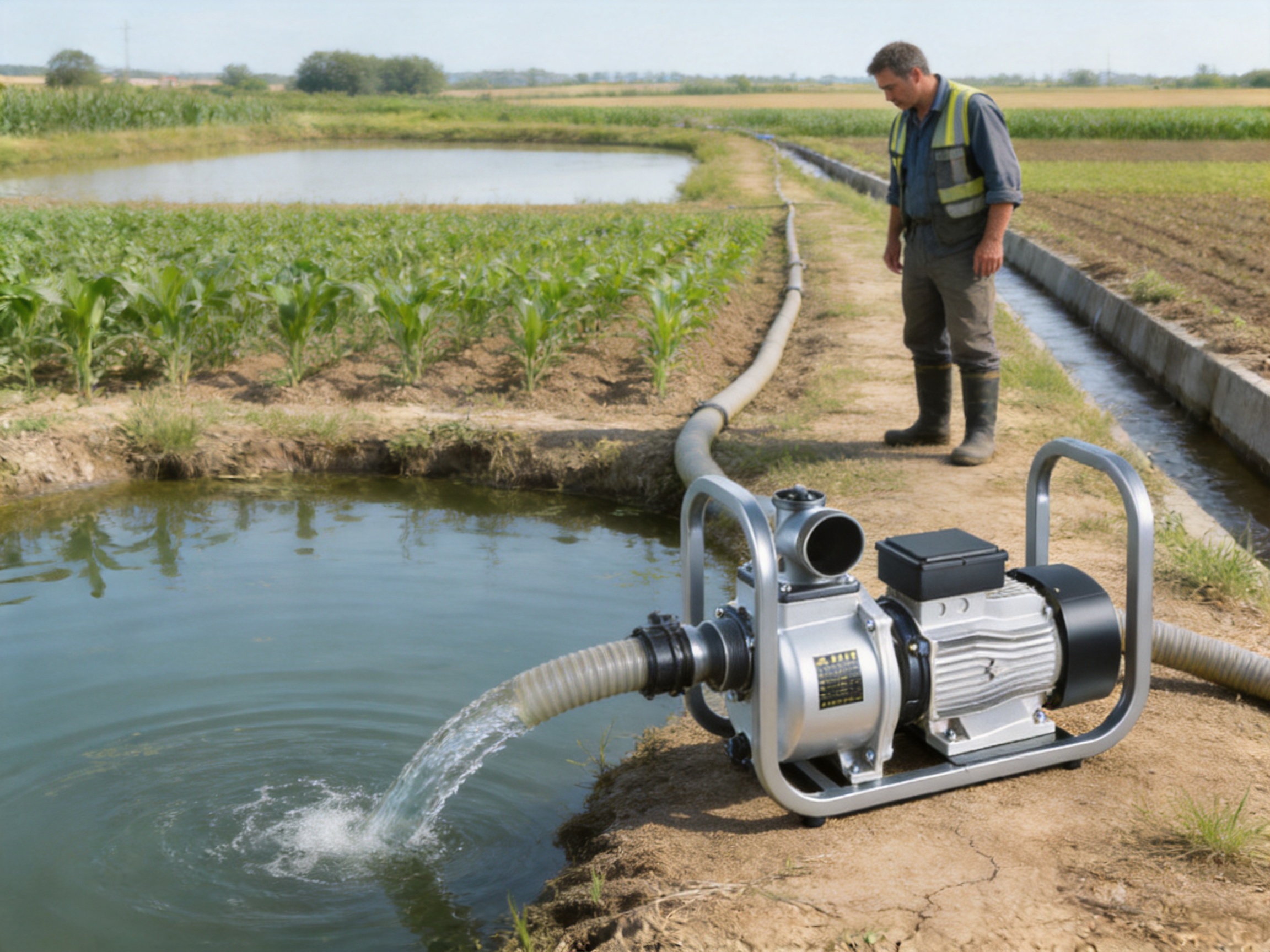
The DSU Series is particularly suitable for irrigation water transfer. It can move water from ponds, reservoirs, storage tanks, canals, or other approved sources toward fields, greenhouses, irrigation networks, and farm water-supply points. The high-flow configuration can help shorten filling and transfer times when the system is correctly sized.
Farm users may also use the pump to transfer water between tanks or support seasonal crop production. The external self-priming arrangement allows the motor to remain accessible while the suction hose reaches the water source. This can be useful where the pump must be removed and stored after the irrigation season.
Drainage and Flood-Control Support
Drainage operations often require rapid removal of standing water. The DSU-50 and DSU-80 can support drainage work in agricultural areas, construction locations, foundation spaces, yards, and other sites where clean or moderately contaminated water must be moved. The operator must verify that the liquid does not contain solids or chemicals that exceed the pump’s intended conditions.
For flood-control support, placement and electrical safety are critical. The pump should be installed above unstable or rapidly rising water whenever possible, with protected electrical connections and secure discharge routing. The 8-meter suction specification should be treated as a design limit rather than a target that every installation can automatically achieve.
Aquaculture and Pond Management
The manufacturer also serves aquaculture and fish-pond applications through its broader product range. The DSU Series may be useful for approved water-transfer tasks around aquaculture facilities, including filling, emptying, or moving water between tanks and ponds. It should not be confused with an aerator: the pump’s principal function is water transfer, while dedicated aerators are designed to increase oxygen exchange.
When used near fish or aquatic organisms, operators should consider water quality, debris control, flow velocity, and the possibility of drawing in small animals. System design should protect stock and prevent damage to the pump.
Construction and General Water Transfer
Construction teams may use high-flow pumps for foundation drainage, site water transfer, equipment cleaning, and temporary water management. The pump’s portable aluminum structure can be advantageous when work areas change during a project. However, construction sites require careful protection against dust, impact, mud, damaged cables, and unstable ground.
For household or landscape applications, the pump may support garden irrigation, pond filling, landscape-lake transfer, and general water supply where the required flow and head match the specifications. It should be installed by users who understand the electrical and hydraulic requirements.
OEM, ODM, and Wholesale Supply Potential
The DSU Series can be relevant to importers, agricultural-equipment distributors, irrigation suppliers, pump wholesalers, and private-label brands. A two-model product family provides a simple way to address different customer flow requirements while retaining consistent series positioning.
OEM and ODM support can be valuable when a buyer requires custom branding, packaging, documentation, labeling, color treatment, market-specific accessories, or product combinations. The feasibility of each customization should be confirmed with the manufacturer before an order is placed. Technical changes affecting the motor, hydraulics, voltage, or casing may require additional engineering review and testing.
For distributors, product training should cover the difference between maximum flow and actual system flow, the importance of suction-line sealing, the 8-meter suction limitation, electrical requirements, and the distinction between external self-priming pumps and submersible pumps. Clear sales information reduces incorrect applications and supports better customer satisfaction.
The manufacturer’s location in Wenling, Zhejiang Province, places the company within a region known for mechanical and electrical manufacturing. Its stated product breadth, research and development focus, and international technical-support approach can provide a foundation for serving global buyers. Buyers should nevertheless evaluate purchase terms, lead time, inspection arrangements, packaging, warranty terms, and after-sales procedures for each project.
Why the DSU Series Is a Competitive Choice
The DSU Series combines several characteristics that are often requested by agricultural and commercial buyers: high water-transfer capacity, a 28-meter maximum lift, an 8-meter suction specification, aluminum alloy construction, self-priming operation, moderate power demand, and two practical model sizes.
Its main competitive advantage is balance. The pump is not designed only for maximum pressure, nor only for minimum weight. Instead, it aims to provide useful flow capacity in a portable body with a hydraulic configuration suited to common irrigation and drainage work.
The external self-priming structure can be more convenient than a submersible arrangement for users who prioritize accessibility and storage. The aluminum construction can be more manageable than heavy metal alternatives. The two model options allow buyers to select a capacity closer to their application rather than using one oversized pump for every task.
The product is also supported by a manufacturer with a wider portfolio of aerators, pumps, and air blowers. This broader expertise can be valuable for buyers seeking multiple types of aquaculture, irrigation, drainage, or environmental equipment from one supplier.
As with any pump, the DSU Series performs best when properly selected and installed. Its advantages should be considered together with the actual water source, pipe network, electrical supply, liquid quality, operating schedule, and maintenance plan.
Q&A
What is the DSU Series high-flow electric pump used for?
The pump is designed for water transfer applications such as irrigation, agricultural water supply, drainage, tank filling, pond transfer, construction-site water management, and selected landscape or general water-supply tasks.
Is the DSU Series a submersible pump?
No. It is designed for external installation and self-priming operation. The pump does not need to be submerged like a traditional submersible pump, although the suction hose must be placed correctly in the water source.
What is the maximum flow of the DSU-50?
The DSU-50 has a listed maximum displacement of 25 m³/h. Actual flow depends on the total head, pipe diameter, pipeline length, valves, bends, suction conditions, and other system factors.
What is the maximum flow of the DSU-80?
The DSU-80 has a listed maximum displacement of 50 m³/h. It uses an 80-size inlet and outlet and is intended for higher-volume transfer than the DSU-50.
What is the maximum lift?
Both the DSU-50 and DSU-80 are listed with a maximum lift of 28 meters. The real operating flow at a particular lift should be confirmed through a complete hydraulic calculation or performance curve.
How high can the pump suction reach?
The listed maximum suction is 8 meters for both models. Suction performance depends on airtight connections, water temperature, pipe condition, elevation, inlet restrictions, and correct priming.
What materials are used in the pump?
The motor housing and pump casing are made from aluminum alloy. The impeller uses a flow-channel design, and the volute also uses a flow-channel structure.
What voltage and frequency are specified?
The listed voltage is 220/380 V and the listed frequency is 50 Hz. Buyers must verify the available local power supply and have the pump connected by a qualified electrician.
Which model should a farm choose?
The DSU-50 may be suitable for moderate water-transfer requirements up to its rated application range, while the DSU-80 is intended for larger flow requirements. Selection should consider the required flow, pipe size, elevation, distance, and power supply rather than maximum displacement alone.
Can the pump handle dirty water?
The supplied information identifies the pump for water-transfer applications but does not define a specific solids-passage rating. Users should prevent large solids and debris from entering the pump, use an appropriate strainer, and consult the supplier before pumping abrasive, corrosive, chemically treated, or heavily contaminated liquids.
Does the pump need to be filled before operation?
Self-priming operation still requires correct preparation. Follow the applicable operating instructions regarding initial filling and priming. The pump should not be run dry, and the suction line must be airtight.
What are the main advantages of aluminum construction?
Aluminum alloy can help reduce weight while providing a practical combination of strength and durability for ordinary water-transfer applications. The lighter structure can make the pump easier to transport and reposition.
Can the DSU Series be used for aquaculture?
It may be used for suitable water-transfer tasks around aquaculture facilities, but it is not an aerator. Operators should consider water quality, stock protection, debris control, and the suitability of the flow for the particular aquaculture system.
Does the manufacturer provide OEM or ODM services?
The manufacturer states that it provides customized OEM/ODM services and professional technical support for customers worldwide. Specific branding, packaging, electrical, accessory, and engineering requirements should be confirmed before ordering.
Conclusion
The DSU Series high-flow electric pump is a practical solution for users who need efficient water movement without the weight and installation complexity associated with some conventional pump designs. Its aluminum alloy motor housing and pump casing support portability, while the flow-channel impeller and volute are designed for stable hydraulic performance.
With the DSU-50 offering a maximum displacement of 25 m³/h and the DSU-80 offering up to 50 m³/h, the series covers a useful range of irrigation, drainage, farm water-supply, construction, pond, and general transfer needs. Both models provide a listed 28-meter maximum lift and 8-meter maximum suction, together with 2,900 rpm operation, 50 Hz frequency, and 220/380 V electrical specifications.
The pump’s self-priming, external-installation arrangement is an important advantage for users who value accessibility, mobility, and easier seasonal storage. Its moderate power range and low power-consumption design can also support economical operation when the pump is matched correctly to the pipe system.
Behind the product is a manufacturer with experience in aerators, pumps, air blowers, and other mechanical and electrical equipment. Zhejiang ZhenTai Mechanical and Electrical Co., Ltd. combines product development, multi-series manufacturing, OEM/ODM capability, and technical support for global buyers. For agricultural distributors, wholesalers, farm operators, and project contractors, the DSU Series offers a balanced combination of capacity, portability, practical installation, and application flexibility.
References
1. Product specification and technical information supplied for the DSU Series high-flow electric pump.
2. Manufacturer profile and company information supplied for Zhejiang ZhenTai Mechanical and Electrical Co., Ltd.
3. General principles of centrifugal pump selection, including the relationship between flow, head, pipe resistance, and operating conditions.
4. General guidance for self-priming pump installation, suction-line design, priming, and dry-running prevention.
5. General agricultural irrigation and drainage equipment selection practices.